Understanding Variables in Statistics: A Simple Guide
Exploring Quantitative and Qualitative Variables with Real-World Examples
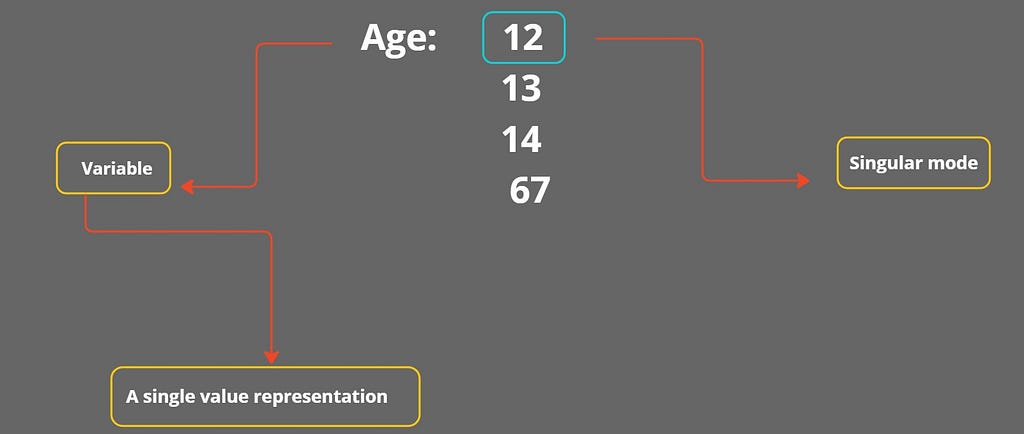
A variable in statistics is simply something that can change or vary across different observations. Think of it as a “container” that holds information, and the information it holds can be different from one case to another.
Example:
Age is a variable because different people have different ages. You can ask five different people their ages, and you might get answers like 18, 25, 30, 42, or 50. The ages are the values, and the variable here is age. The only thing that’s being measured or recorded is the age, which makes it the variable in this situation.
Real-world applications:
To put it in everyday terms: Imagine a survey where you’re asking people their age. The question “How old are you?” represents the variable, and the number each person provides (like 25 or 30) is the value that gets stored for that variable. So, in this case, age is the variable, and each person’s specific age is the value that the variable holds.
Types of Variable
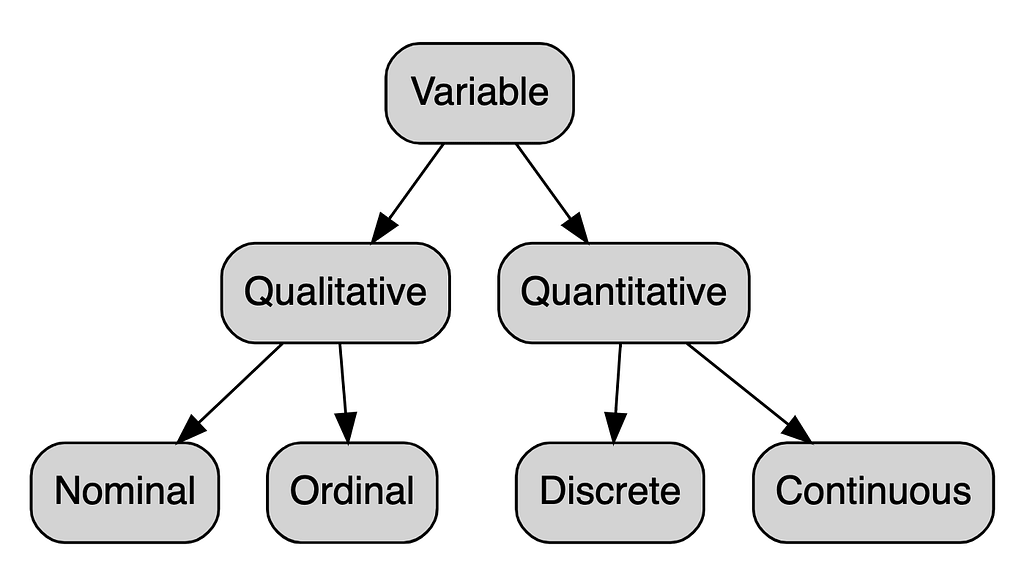
1. Quantitative Variables
Quantitative variables represent numerical values that can be measured or counted. These variables deal with quantities and answer questions like “How many?” or “How much?” They are further divided into two subtypes:
- Discrete Variables: These represent countable, whole numbers and are often associated with things you can count.
Example: The number of books on a shelf (e.g., 5, 10, 15 books). You can’t have half a book when counting.
- Continuous Variables: These can take any value within a given range and are measurable, often involving fractions or decimals.
Example: A person’s height (e.g., 5.75 feet or 170.2 cm). Height can take a wide range of values, even in fractions.
2. Qualitative (Categorical) Variables
Qualitative variables represent categories or labels and describe qualities or characteristics. These variables answer questions like “What type?” or “Which category?” and are not measured with numbers. They are not inherently numerical, but sometimes they can be coded numerically for analysis.
Example: Hair color (e.g., black, brown, blonde) or the type of car (e.g., sedan, SUV, truck).